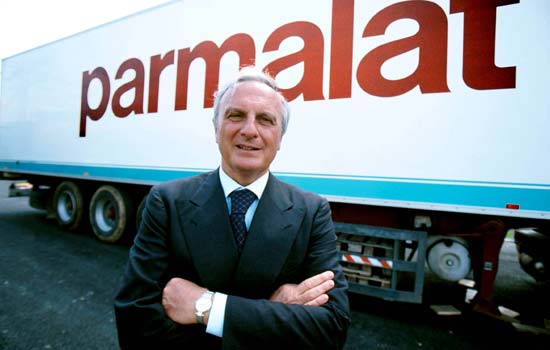
Il Gioiellino, The Jewel, a 2011 movie that was recently released in Italy on DVD, is loosely based on the biggest financial scandal in Italian history. The movie tells the story of a company called Leda, a humbly begun salumeria that became a multinational food corporation; in real life that company was Parmalat.
Parmalat , a food giant and the leader in the production of ultra high temperature (UHT) Milk, collapsed in 2003 with a €14 billion ($20bn; £13bn) hole in its accounts in what remains Europe’s biggest bankruptcy. At one time the largest Italian food company and the fourth largest in Europe, controlling 50% of the Italian market in milk and milk-derivative products, it was discovered that its claimed liquidity of 4 billion euro did not exist, and that € 8 million in bonds of investors’ money had evaporated as well. A whole can of worms opened up exposing dirty business practices by Parmalat and other companies around the world.
The Parmalat bankruptcy is the biggest in European history, representing 1.5% of Italian GNP—proportionally larger than the combined ratio of the Enron and WorldCom bankruptcies to the U.S. GNP. Its 34,000 employees’ and investors’ money was syphoned off into a network of 260 offshore speculators and it disappeared.
In the late 90s Parmalat decided it wanted to expand and become a global player, acquiring companies in North and South America, a tourist agency called Parmatour, a Formula One car, Odeon TV, and a Soccer club – all financial disasters. In December 2003 Parmalat had difficulty making a €150m bond payment and the company was supposed to have been sitting on €3.95bn in cash, so Italian bankers were puzzled by its predicament. Parmalat’s founder, Calisto Tanzi, brushed bankers’ concerns aside, saying the company had a bit of a liquidity problem. With “invented” books company executives hid a debt of €14.3bn, which was almost eight times the sum originally stated. Hundreds of thousands of investors lost their money and would never recover it.
Tanzi was sentenced to 10 years in prison for fraud and seven other defendants, including executives and bankers, were acquitted. Another eight defendants settled out of court in September 2008.
The company never was declared insolvent but never went bankrupt; the Italian government helped save the trademark and since 2011 it has been a subsidiary of French group Lactalis.
 I Love Italian Everything