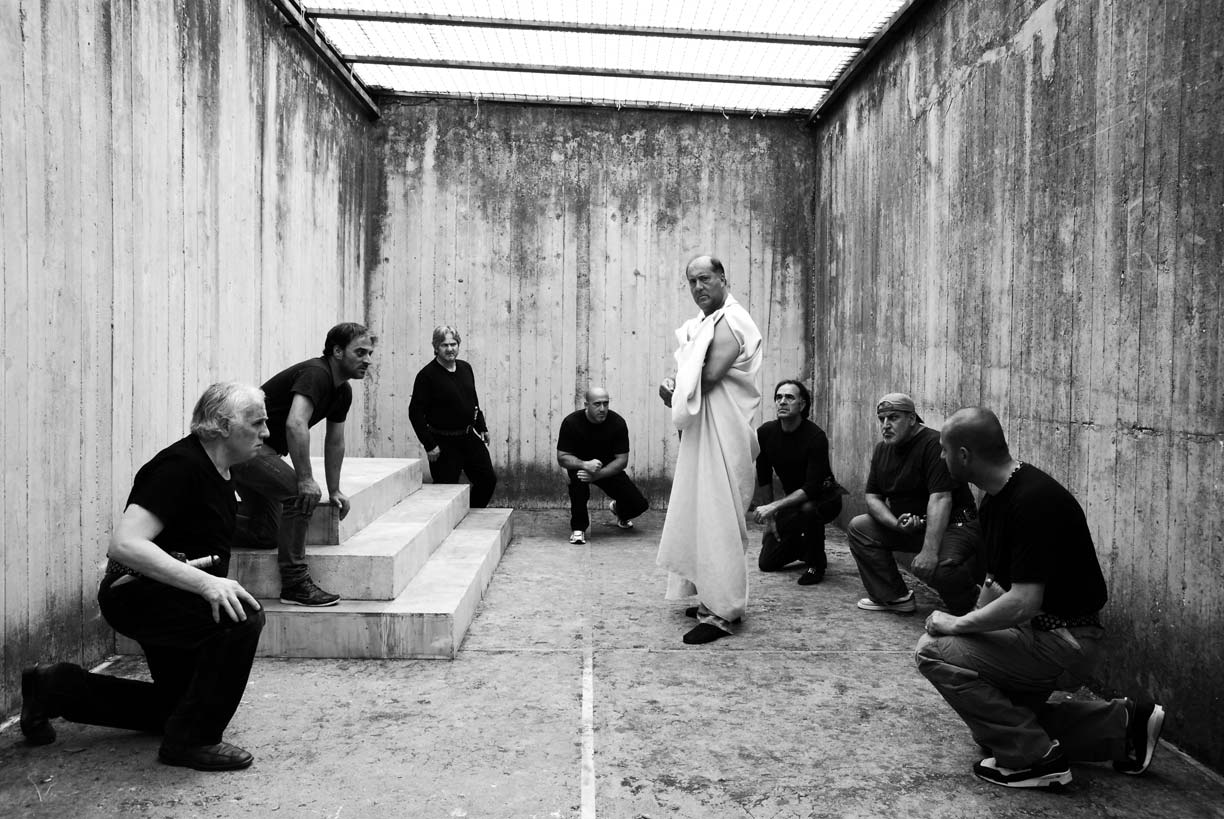
 I’d been waiting what seemed like forever for the Berlin Film Festival Golden Bear Winner Cesare Deve Morire (Caesar Must Die), from directors Paolo and Vittorio Taviani, to come out on DVD and last week it finally arrived from ibs.it . The day that it got here my husband was out-of-town and he asked me to wait and watch it with him, so I did, but when we finally sat down and popped it in my region free DVD player we were disappointed; there were no English subtitles for Brian.
He went to bed and I watched it; I was alternately overwhelmed by emotion by the powerfully told docudrama and annoyed that Brian wasn’t able to enjoy it. The US distribution rights for Cesare Deve Morire were acquired by Adopt Films and they say they’ll release it this fall here in America, so all is not lost. I’m still very surprised that a film that has been so applauded did not come with English subtitles, even if for the rest of the European community who tend to use English as a common denominator.
The movie is everything I hoped it would be, using real inmates at a real maximum security prison in Rome who are staging a production of Julius Caesar. These inmates, nearly all incarcerated for drug trafficking or organized crime activity, played all the parts in the production and used it as an opportunity to tell their own stories as well as Shakespeare’s.
“We said they could use any name they like and make up biographical details but none did, they all told their real stories,” said Paolo Taviani. “They realized this film would be seen in theaters, maybe by people, by friends, who had forgotten them. This was their way of crying out: We’re here! We’re alive!”
Beginning with inmates auditions, the director tells the men to tell who they are and where they are from two times, once, sadly, as if their wife had just left them, and then with defiance and anger. The men who are chosen for the parts are stunning just trying out for the parts, weeping, growling, and whispering their names, the names of their fathers, and their hometowns.
And as the film progresses, the men learn their lines and practice scenes in their cells and behind the walls of the prison, with guards looking on, obviously very surprised by the emotion and the dedication to the project.
Paolo Taviani said “We hope that when the film is released to the general public that cinemagoers will say to themselves or even those around them… that even a prisoner with a dreadful sentence, even a life sentence, is and remains a human being”.
If you understand Italian even a little bit, you’ll enjoy this movie. It’s beautiful to watch, mostly in black and white, and the inmates faces and gestures tell much of the story. And when it’s released with subtitles in the US, Americans, please see it. You’ll be changed, as I have, just a little, and reminded that there is humanity in us all, even ones who have done something terrible and lost the right to interact with us.
Directors: Paolo Taviani, Vittorio Taviani
Writers: William Shakespeare (excerpt from play Julius Caesar), Paolo Taviani (screenplay)
Stars:
Salvatore Striano as Bruto (Brutus)
Cosimo Rega as Cassio (Cassius)
Giovanni Arcuri as Cesare (Caesar)
Antonio Frasca as Marcantonio (Mark Antony)
Juan Dario Bonetti as Decio
Vincenzo Gallo as Lucio
Rosario Majorana as Metello
Francesco De Masi as Trebonio (Trebonius)
Gennaro Solito as Cinna (Cinna)
Vittorio Parrella as Casca (Casca)
Pasquale Crapetti as Legionär
Francesco Carusone as Wahrsager
Fabio Rizzuto as Stratone
Maurilio Giaffreda as Ottavio
Fabio Cavalli as Theatre director
 I Love Italian Everything