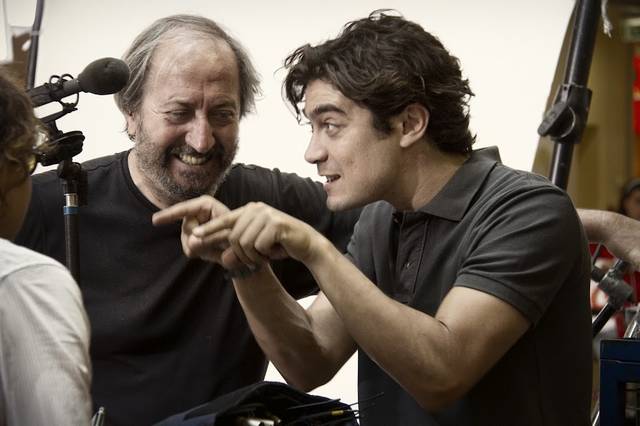
He isn’t one of the directors that pop into the minds of Americans when we think of Italian directors, but in many ways he’s one of my favorites. Giuseppe Piccioni directed a movie that was one of the first I ever saw in an Italian movie theater, and a movie that remains at the top of my list, La Vita Che Vorrei with Luigi Lo Cascio and Sandra Ceccarelli .
La Vita Che Vorrei (the life that I want) never got enough credit. Directed by and with a screenplay credit for Piccioni, It’s about Stefano, an arrogant movie star, played by Lo Cascio, who meets and falls in love with Laura, a self-serving aspiring actress. In their very imperfect love story, it’s a “movie within a movie”, with the plot of the film they are cast together in mirroring what is happening to them in real life. She thinks that he’s a nasty prick, and he is; he thinks that she’s kind of a whore, and she kind of is – so is this love, or how can their attraction be explained? There is nothing idealistic about their very authentic and painfully honest romance and I like this one so much I’ve watched it a dozen times.
Laura: So di dover imparare ancora tante cose ma non posso farlo con te…con te io mi sento peggiore di quello che sono. (I know that I still have a lot to learn but I can’t do it with you. You make me feel like a worse person than I really am.)
Piccioni is more well know for another film that paired Lo Cascio and Ceccarelli, Luce Dei Miei Occhi (light of my eyes) – and it’s good, too. Again, the romance is a flawed one, between an introverted driver for a car service and a single mother who is having an affair with a married man.
Ceccarelli’s character tells Lo Cascio’s: Ma se sei tu che mi stai sempre intorno… non impazzisco di gioia quando ti vedo, non mi batte il cuore, non mi sento perduta quando te ne vai… è così… non è colpa mia.( But if you’re always around…I don’t go crazy with joy when I see you, my heart doesn’t beat faster, I don’t feel lost when you go away. That’s how it is…it’s not my fault.)
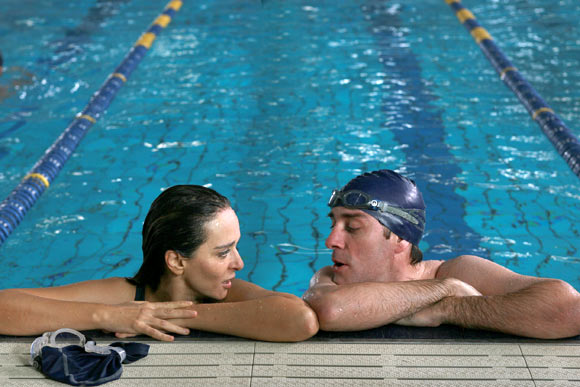
Luce Dei Miei Occhi is available for rental and purchase in the US and there are English subtitles, along with Piccioni’s Giulia Non Esce La Sera (Giulia doesn’t date at night), about a woman who meets a man when she’s on prison work release and starring Valeria Golino and Valerio Mastandrea. You’ll also easily find Piccioni’s Fuori Dal Mondo (not of this world), about a nun, a businessman, and an abandoned baby; this one was Italy’s entry for the Oscar for best foreign film in 1999.
Piccioni’s newest movie, Il Rosso e Il Blu (the red and the blue) was just released in Italy and is getting rave reviews. It stars everybody’s favorite Riccardo Scamarcio, with (one of my favorites) Margherita Buy and Roberto Herlitzka. The trio plays high school teachers, and though the premise seems a little worn out to me, it’s been so far very well received.
Piccioni is the director that made me realize that there is a new wave in Italian cinema. At 59 and in his third decade of making movies he has made a bunch of them that are nothing like the overly sentimental love stories that Italian filmmakers are known for. His characters are more real and their situations are as far from perfect as his movies are close to it.
 I Love Italian Everything