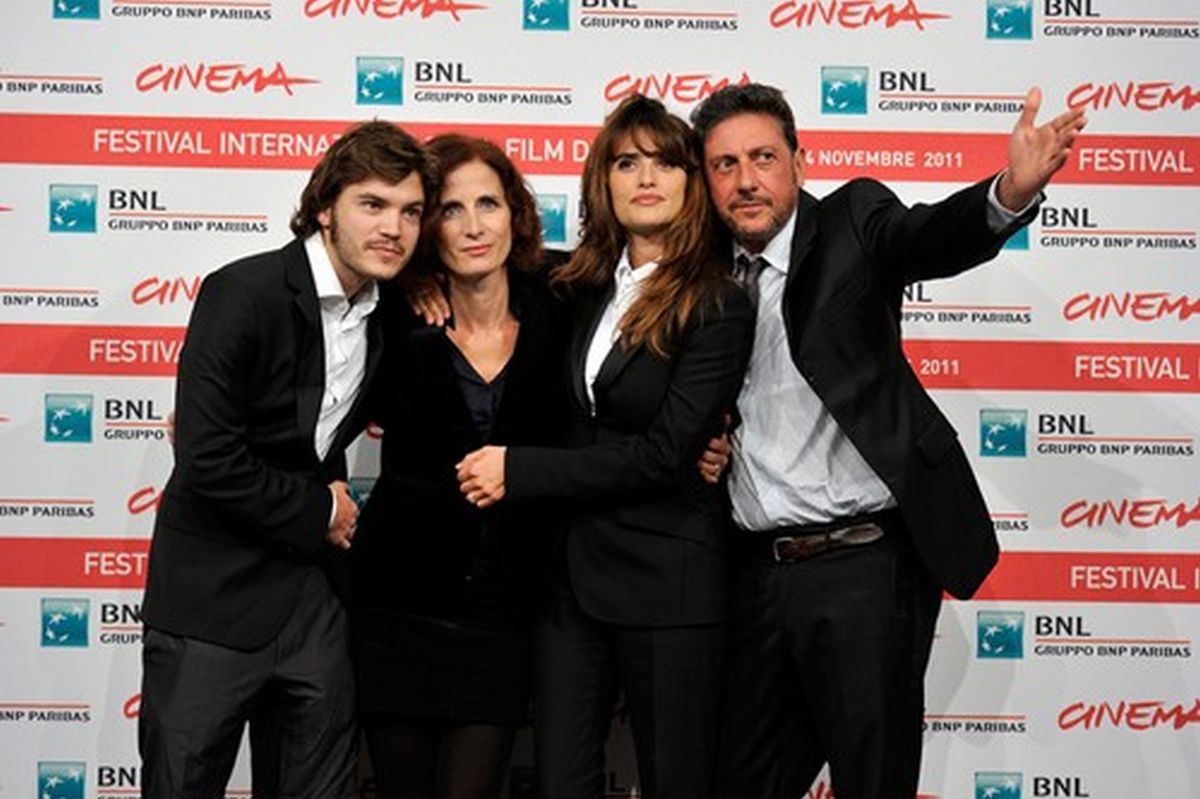
An interview that I’ve translated from Leiweb.it by Alessandra Mattanza
Sergio Castellitto: “Talent isn’t enough; acting takes courage.”
The actor returns to the director’s chair with Venuto Al Mondo (Twice Born), a story based on his wife Margaret Mazzantini’s best-selling novel by the same name, and 8 years after Non ti Muovere, he casts Penelope Cruz in the starring role. Of his future, Castellito has no doubts; “I’m an actor and once in a while I amuse myself directing”.
Sergio Castellito arrived at the Toronto Film Festival with the whole family to present Venuto Al Mondo and said that he chose Toronto because ” it’s said that there you’ll find the true cinefiles”.
In the film Penelope Cruz plays Gemma, in love with a war photographer played by Emile Hirsch.
Can you tell us about the idea to make the book into a movie?
From the first time I read the book I tried immediately to imagine the film. Margaret has a visual way of writing that lends itself well to the screen. I worked on it for 3 years and I can say that this film is truly like a part of my body.
What’s it like to work with your wife?
We work and live together and we advise each other about everything; film, cooking, and clothes.
You’ve chosen Penelope Cruz again, who has gone on to be a big international star since Non ti Muovere.
Penelope read the book and fell in love with the character, Gemma. I absolutely wanted her for this role. It’s the first middle class character that she’s ever played so for her it’s a very different choice.
How do you like working with her?
Penelope is humble and ambitious at the same time. And more than that courageous, she isn’t afraid to make fun of herself even to the point of seeming ridiculous. A talented actor must always risk everything, asking himself every time if he has really given his all in a scene. Penelope read the book every day on the set, even more than the script, and took notes. It became a sort of Bible for her, and Margaret was always there to offer advice.
Would you like to collaborate in the same way with other American actresses?
There are a lot that I love…I would love to work with Kate Winslet, but I need to find the right project to propose to her. We’ll see – I hope to be able to do that one day.
For the role of DIego you chose Emile Hirsch. Why?
Ever since I saw him in Sean Penn’s “Into the Wild” I thought that this part should go to Emile, for the intensity of his acting and the will to immerse himself with great passion in a character. He was the only betrayal to the book, because there the character is Italian and in the film he became instead an American photographer.
What was the most difficult thing about making this film?
To make a film means overcoming every day an obstacle, even if it’s going relatively smoothly. On the set we are sometimes speaking different languages and using hand gestures to communicate. Everybody was immediately very passionate about the story and it was really beautiful, so it was difficult not to remain involved with each other.
What did you notice in particular?
This film can be seen on many different levels and one of these is the act of devotion versus the pain that women have during war or in their daily lives. It speaks of violence, and in particular, like the kind that Saadet Aksoy demonstrated in a rape scene, showing an incredible courage facing fear and difficult times. As I’ve said before, a great actor must first have courage; talent isn’t enough.
At this point in your career, what do you prefer, acting or directing?
I am above all an actor and once in a while I amuse myself directing. When I’m directing I do it with such strong emotion that it’s almost like a student’s. To make a film is a lot of work because you have the chance to put all of these thoughts and emotions into your hands, a very intense and personal process. And it’s not just the film, but also the memories that remain between everyone that has participated.
In the end, which is better – the film or the book?
The book. The book is always better.
Margaret, Sergio’s wife, who had been in the room but had remained silent throughout the interview had the last words, disagreeing with her husband:
“The film“, she said. “The film is really beautiful.”
 I Love Italian Everything