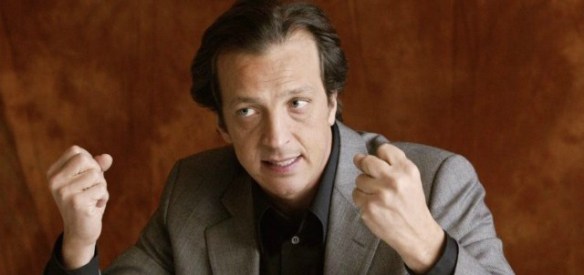
Interview translated From La Repubblica
Everyone has the right to use their own talents however they want and Gabriele Muccino decided to put his to use in the service of the Hollywood star system. After two films with Will Smith (The Pursuit of Happyness and 7 Pounds) , a third American film, Playing For Keeps was just released in USA theaters and will be released in Italy on January 10 with the title Quello Che Do Sull’Amore.
WIth the amazing cast, the Scottish sex symbol Gerard Butler, Jessica Biel, Uma Thurman, Catherine Zeta-Jones, and Dennis Quaid it earned 6 million in the first weekend.That’s not really a flop but it’s not a huge success, especially for Muccino who with his last two titles earned half a billion, more than any other Italian director.
The critics have ripped it to shreds, and Playing For Keeps is an example of how Hollywood kills its talent. The story could have been original and interesting, that of an ex-soccer player ended his career badly in a championship game in the US who loses everything but decides to try to get back the love of his ex-wife and son.
A sad story of the American dream and disappointments, family chaos, and a forty-year old that has entered maturity following the path of a soccer ball. It begins to sag with a storyline that seems straight out of Desperate Housewives, with Uma Thurman and Catherine Zeta-Jones playing frustrated wives that have the hots for Gerard Butler. The predictable outcome is not what Muccino had in mind.
So what happened? The first answer came from Muccino when I talked to him in his Manhattan hotel, thirty pounds overweight from stress and worn out from the ordeal. He seemed like a completely different person from the director of L’Ultimo Bacio.
“I came here to be their gladiator without the necessary equipment. With Will Smith it was a walk in the park, he let me be free to make the movies as I wanted to. This time I get it – the real Hollywood is a ruthless industry where people lie from morning until night.”
“They only care about the graphics, the marketing and the profits”.
The mistake was maybe including hints of the bittersweet Italian comedies movie to an international audience?
“Yes, here in America, the genres are set in stone…in a sentimental comedy certain things are expected to happen…I get why Woody Allen’s making movies in Europe now.”
In the middle of the outburst, all of a sudden in walks Bruce Willis, in NYC for a premier. He greets him warmly and showers him with compliments. It’s curious to hear a Muccino talk like this, one that is adored by the stars, and allows himself the luxury of refusing enormous offers, like directing the third Twilight movie. America recognizes his talent.
“They recognize it and they pursue it, but like the lion pursues the gazelle, to tear it to pieces.”
“One might imagine that the difficult part is directing Butler, Uma Thurman, Jessica Biel, or Dennis Quaid, but instead that part’s fun. The hard part is off the set, in the show business part. There’s no respect for the intelligence of the public. If I had to make a list after seven years and three films in the US, I have to say that I have learned a lot of things as a director and as a man. But maybe I was calmer when I had less.”
Today he’s flying to Rome.
“I can’t wait.”
In the immediate future he’s got two projects, one American and one Italian; he’ll have to choose.
“By now I’m already with one foot here and another on the other side of the ocean.” Extreme uprooting even for someone like him. “But I haven’t given up the idea of bringing something from America to Italy and vice versa.”
What is missing from Italian cinema that keeps it inside the Italian borders?
“The true desire to really do it. We have the talent. We might be lacking a little in scriptwriting; my generation doesn’t have Age and Scarpelli. Besides this, we remain a closed society, suspicious of the world. Berlusconism was all about that, a stubbornly provincial abnormality masquerading as modernism.”
Hidden in his films there is always a classic model of Italian cinema. I Vitelloni behind L’Ultimo Bacio, Bellisima for Ricordati Di Me, the relationship between father and son from The Bicycle Thief in The Pursuit of Happyness and also in Playing For Keeps.
“No cinema has produced so many masterpieces in so little time as in Italian cinema between the years after the war and the 1970s. And are they still relevant? No, they are more than relevant, they are progressive even today. For me to watch our classics doesn’t mean looking at the past, but at the future.”
 I Love Italian Everything