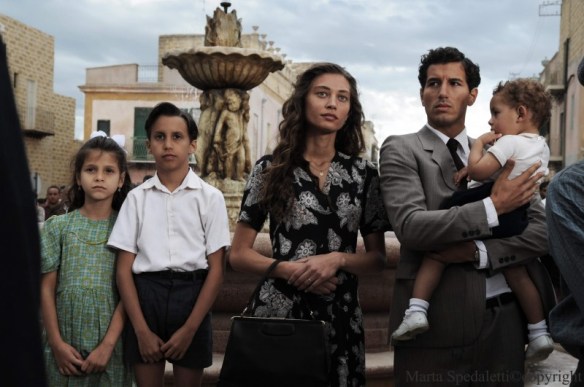
 I was pretty dismissive of Giuseppe Tornatore’s semi-autobiographical Baarìa the first time I watched it, writing that it reminded me of a 2 1/2 ad for Barilla pasta.
Sorry about that.
Watching it again I’m not sure why I was so hard on it. It’s still not my favorite, but watching it with my husband, through his Italian-American eyes, I saw something different. My husband, a man who is very often fast asleep after watching 15 minutes of a movies with subtitles, was immediately absorbed in Baarìa’s story of generations of a Sicilian family, and when it was over, he rewound and watched the ending again. The ending is the best part, no doubt about it. It does what an Italian movie does best, grabbing all of our emotions and doing with them as it pleases.
Read what my husband, Brian Passell (“Paceleo” before immigration changed the family name in the early 1900’s) said about Baarìa.
Remember, you can watch Baarìa with subtitles on Netflix, Amazon, YouTube, iTunes and Vudu so there’s no excuse not to.
Baarìa ( by Brian Passell )
On one level it is easy to dismiss Baarìa as an overly sentimental, clichéd and trite version of good cinema. The sweeping landscapes, the perfect light, the vast cast look like an American imagining what Sicily should look like based on other movies they saw. That wasn’t it for me.
I saw a movie that while it did focus on what is good about Italy, family, generosity and history, it never over-sentimentalized a hard story about three generations of poverty and lack of opportunity. The film highlighted the class war that exits even today. In the caste system that was Sicily, it was pretty difficult to break out of your place. Corrupt government, organized crime, the haves and have-nots all battle for their little space on the map. The odds are against you if you aren’t at the top.
Even today, there are legions of youth 18-30 jobless, living with their families. In this corner of Sicily, one boy went from a shepherd and a boy humiliated in a school room to eventually sending his own son off to the city to “earn a living”. It wasn’t a perfect story, it wasn’t really a happy ending in the classic sense. It was a tribute to the merits of never giving up. As you pictured the little boy running on the errand to earn 20 lira, you didn’t realize that you would be privileged to see a man’s life that never let him stop running, and in the end you know that it couldn’t have been any other way.
He was always about the positive, about looking at the challenge as always achievable. He wanted the justice that the hammer and sickle promised. The symbol has always linked the factory worker and the farmer as equals to any man, justice and fairness. When justice wasn’t there, he never despaired. He didn’t lash out at the world. Sometimes with a simple shrug his practicality won the day. When his best friend wanted to kill himself, he disarmed him in the way the ultimate pragmatist can. There are many stories of people leaving their homes for something better.
Baarìa showed us a man who made the best of his life where it was, enjoyed doing it and never stopped running.
 I Love Italian Everything