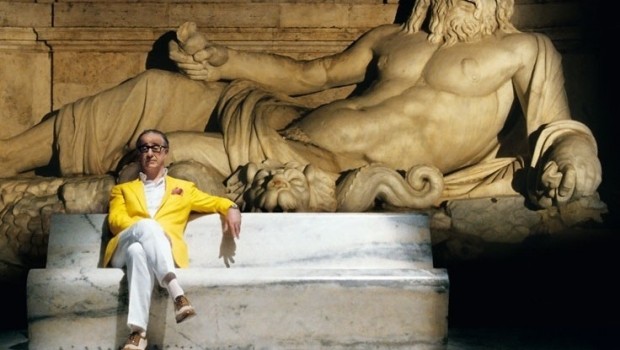
Reviews from Cannes are in, and from the looks of them Paolo Sorrentino has a chance with his La Grande Bellezza: The Great Beauty, which has just a few hours ago premiered there has a chance at the Palme D’Or!
From Peter Bradshaw at The Guardian:
Paulo Sorrentino’s magnificent return to form sees him reteam with Toni Servillo for a lush, classical tale of middle-age hedonism and lost love. (He’s) returned to Cannes with a gorgeous movie, the film equivalent of a magnificent banquet composed of 78 sweet courses. It is in the classic high Italian style of Fellini’s La Dolce Vita and Antonioni’s La Notte: an aria of romantic ennui among those classes with the sophistication and leisure to appreciate it. The grande bellezza, like the grande tristezza, can mean love, or sex, or art, or death, but most of all it here means Rome, and the movie wants to drown itself in Rome’s fathomless depths of history and worldliness.
Toni Servillo is wonderful in the role, his sad-eyed gaze made more intense with blue contact lenses. He is not disappointed by life, nor even by the people who fail to realise that life is disappointing, but endlessly tolerant, with the weary elegance of a vampire.
This movie looks and feels superb, it is pure couture cinema. But there is also an excess of richness and bombast and for all its sleekness I felt that the spark of emotion was being hidden, and there is a kind of frustration in the operatic sadness. It is a brilliantly executed, glitteringly hypnotic film, though, one of the very best in the festival and it is time for Toni Servillo to get his best actor award here.
From Jay Weissberg at Variety:
A densely packed, often astonishing cinematic feast that honors Rome in all its splendor and superficiality.
Very much Sorrentino’s modern take on the themes of Fellini’s “La dolce vita,” emphasizing the emptiness of society amusements, “Great Beauty” will surprise, perplex and bewitch highbrow audiences yearning for big cinematic feasts.
There’s something about Servillo’s manic smile that always suggests world-weariness; he lacks the seductive lassitude of Marcello Mastroianni’s Fellini figures, but he’s aiming for something else, specifically the waste of a promising intellect in thrall to emptiness. Sorrentino populates his film with some of the strongest actors in Italy, thesps like Galatea Ranzi and Roberto Herlitzka who make small roles memorable with the force of their understanding.
From The Hollywood Reporter:
Director Paolo Sorrentino knows better than to imitate a giant, and The Great Beauty is more a reverent bow, picking up where La Dolce Vita left off 53 years ago.
Humor plays a major role in making the film enjoyable, and there are a lot of laugh-out-loud moments that capture human absurdity and frailty. Sorrentino, like Fellini, finds the right touch of respectful amusement depicting the Church and the aristocracy. The wizened Cardinal played by Roberto Herlitzka, who is rumored to be the next Pope, brushes aside spiritual queries to ramble on about how to cook duck. The impoverished old prince and princess Jep hires for a party are dignified relics of a world gone by, still surrounded by the grand architecture and art of their ancestors.
Since so much lies in the images, D.P. Luca Bigazzi plays a major part in the creating the film’s distinctive look. His feeling for Baroque palazzi and statues, streets and piazzas captures the haunting beauty of the title, finally embodied by a flock of graceful flamingos taking wing over the city at dawn. The upside of the tale seems to be that, whatever the future holds, there will always exist the breathtaking, heart-breaking beauty of Rome, and the final shots from the Tiber river can be read as a consolation.
From Federico Boni at Swide
The Great Beauty: Sorrentino’s masterpiece.
Rome is told by the mastery of our greatest living director, Paolo Sorrentino, who with La Grande Bellezza (The Great Beauty) has given life to a film that viewed in 30 years’ time will continue to portray Italy today, that of the years 2000. Italy, culturally crumpling upon itself, empty, vulgar, swollen by botox and useless words which echo in the decadent mouths of Rome’s bourgeoisie, bored and dragged between parties and conga lines that inevitably lead no where.
Expert and stylistically brilliant, lyrical and encompassing, La Grande Bellezza by Paolo Sorrentino is today’s La Dolce Vita.
Within La Grande Bellezza by Paolo Sorrentino lives that old time cinema, which today we watch with admiration and nostalgia, bit especially with the awareness of today’s reality, which rhymes with decay: cultural, social, religious and political. Here it is perfectly amalgamated within a cryptic oeuvre, at times incomprehensible, between giraffes which pop out of nowhere and pink flamingos flying over the Coliseum, yet of a perturbing courage and beauty. So much so that it takes your breath away and obliges you to think, over and over again. Even 24 hours after the show, like is happening to me.
Simply, Thank you.
Thank you to Paolo Sorrentino
 I Love Italian Everything