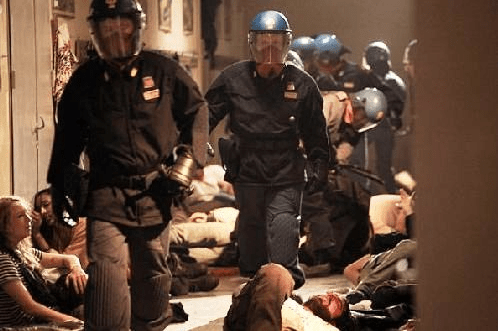
Nominated for Best Picture in the David di Donatello Competition this year is Daniele Vicari’s stunning account of final days of the 2001 G8 Summit in Genova, Diaz: Don’t Clean Up This Blood (Non Pulire Questo Sangue).
Talking to the victims was an operation that took two years. What I read and what I was told was harder than what I showed in the movie. There are some things that were not possible to show unless I wanted to do a slasher film, ” said Vicari of his film about what happened when police raided the Diaz school in Genoa, Italy and beat everyone in it to a pulp.
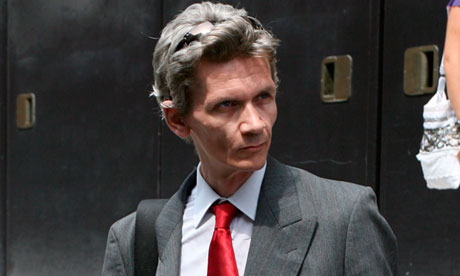
I reviewed the movie in 2012 ( READ MY REVIEW ) and wrote about one of the victims, British journalist Mark Covell, and published an account of the events from his perspective that had been originally published in The Guardian. A few days ago Mark contacted me with more information about the movie, what is happening today concerning the prosecution of the police officers, and about his memories.
Mark says that they’d just had the London premier of the movie and that he was leaving for Rome for the for the Bolzaneto Cassazione verdict when the final 44 police should be convicted for torture. He says that there is still a very serious fight going on in the background of this movie.
Adds Mark, “On the same day as the Bolzaneto verdict, hopefully I get an invite to the Donatello’s to see the film that Procacci has cared so much about, win some of the 13 Donatello nominations it has received.”
“I have answered some basic questions journalists may have about the movie. I saw your article and decided to pass on the Diaz victims review of the movie. I hope this helps you understand how all this happened.”
Thanks Mark. We’ll all be thinking about you.
How do you know Procacci and Vicari?
In Late April 2009, I got a call in London to come to Genova to meet several mystery guests who wanted to meet me and several of the other Diaz victims. I was coming anyway to see Dr Zucca (The Genova prosecutor) but I was intrigued to find out who the mystery guests were. I met Domenico Procacci and Daniele Vicari in Genova at the Via San Luca office (where the Diaz case is archived) in late May for a ‘secret weekend meeting’ after the Cannes Film Festival.
At the time, I did not know who Procacci and Vicari were but I was told they were the best film producer and director in Italy and they wanted to make a movie of the raid on Diaz during the G8. I had seen Gomorrah, Procacci’s mafia film and thought it was brilliant. Using this film as a comparison, I listened to what Domenico wanted to say to all of us present. Procacci explained to us that he had wanted to make a multi-million euro film about the raid for a long time but had been prevented because the trial process against the police.
He was willing to risk a lot of money on the project and we could all see that Domenico and Daniele were committed to making the movie. I personally told them that whilst I had a lot of personal confidence, I thought the Diaz police would try and stop the project or the right ring politicians like Berlusconi or Fini my sue Fandango. I also told them that Diaz is still live court case and that they had to do a lot of research.
After all of us from Diaz consulted with each other, we gave Domenico Procacci and Daniele Vicari permission to make the film. All of us were taking a risk allowing a production company like fandango access to the video evidence & photos and documents involved in the trial. However, we all felt that the story of the raid and what we had lived through had to be told to the rest of the world.
What is unusual about the Diaz movie was that there was no script in existence, so Fandango commissioned Laura Paolucci to spend two years writing a script. The end result is a pulp fiction style film which is 80% true to the story of Diaz. Obviously, Vicari could not go into detail about the entire G8 which forms the backdrop for the beginning of the film but I think Vicari has done an almost perfect job of marrying together true events with a few high drama fictional characters.
Have Diaz victims contribute to the making of the film?
As for the question about whether the real Diaz victims played a part consulting on the film set, the answer is no. Fandango wanted to keep us at a distance for several reasons. Partly for the legal reason the police may bring legal proceedings against fandango and partly for reasons that we would not have to re-live what is a very emotional event and time.
Carlo Baroschmitt, our human rights project manager did provide consultancy to Fandango just to guide fandango on their search for material from our video and photo archive in Via San Luca office. He also produced the Documentary Black Block that accompanies the movie.
What is your personal opinion about the film?
I think the combination of powerful high impact footage, recreated scenes and the chance of lifting the lift on the inside of the anti-globalisation movement makes Diaz the movie a special film. The 2001 G8 was the biggest and worst riot in Europe in 60 years. To complete the film, Vicari has combined the usual high quality style of Italian film screening to capture this important moment of history, making it one of the best, most talked about and most controversial films to come out of Italy in 20 years.
Only after the film had premiered in Berlin did I learn that Procacci had said that Diaz had been his most challenging and complicated film to make…with Vicari in agreement.
My story is played by an Italian actor Pietro Ragusa and my almost death is one of the penultimate scenes in the movie. Because I ran out of Diaz, I took the full force of Canterini’s unit, the 7th Mobile heavy riot unit that had specially trained for the Genova G8 summit. Pietro’s part is almost as it exactly happened and I am very happy despite the scene is one of the most harrowing.
It is a very personal experience for me to watch and relive that moment when I was almost killed at Diaz. Almost twelve years on from that fateful night, I never expected the event to be told on a 30 metre cinema screen, with 130 actors involved, many extras, 70 stuntmen and for the school to be completely rebuilt in Bucharest, Romania.
I have to also say that here I and many others have been in a life and death struggle against fascism and to get justice for what happened at Diaz and Bolzaneto, it has been a bit bizarre…but interesting… to go from talking to lawyers and prosecutors to talking to Paparazzi journalists about a film!
I was the first victim to see the film in its late production stages before it was premiered at the Berlin Film Festival in February 2012. Myself and 35 other victims saw the film in Berlin and so did 1600 other people in the largest cinema in the city. The film was given a standing ovation for 15 minutes and won the audience award.
After the premiere, some of us met the cast of actors during one of the parties. All of them said that they had never worked on a film so meaningful to themselves as Diaz. All of them considered it an honour to finally meet some of us who actually lived through the raid.
The movie had a 400 cinema release in April 2012 and many were reported as packed out…
When the movie premiered in Genova for the first time, many judges, prosecutors and lawyers who had taken part in the case watched the film. Later, In Rome…sections of the Italian government and other politicians saw the film in the Rome parliament. A month later, the movie was shown EU politicians in Brussels who were very shocked.
Diaz will become a ‘cult’ film in my opinion given that nothing compares to it. The movie La Haine – released in 1997- which caused most of the French government to see it …is the only one that can be compared. There is the movie ACAB which critics will mention. This film was shot whilst Diaz was in the making and released just before. The movie follows the lives of several of the 7th mobile police after the Diaz raid. Whilst it is very depressing to watch, it does highlight the kind of culture all of us from Diaz has been fighting.
What did happen that night at the Diaz School?
The Italian legal process for Diaz is finished now with the conviction of 27 super police. Bolzaneto will finish at Cassazione with a verdict on June 14, 2013. Whilst it is expected that all 44 GOM Mobile, Carabinieri, DIGOS and Prison police will be convicted of torture and abuse, none will go to jail because the statute of limitations is expired.
It is a great wish and desire to see Italy pass a torture law to protect its Italian citizens. If there is anything positive to come out of the horrific Bolzaneto story, it would be a new torture law.
We say that the cover-up that came after Diaz as the super police tried to destroy evidence, obstruct justice, threaten victims and lie to cover up their crimes whilst attempted to put a false story out to the global media is important to mention.
This is why Amnesty international calls the G8 the largest suspension of democratic rights in a western country. It was the severity of the human rights abuses at Diaz & Bolzaneto where every law was suspended and the struggle by the victims to win justice which lead them to make this statement in the summer of 2007. They witnessed the course of progress of one of the most important, largest and controversial human rights case pass through and test the Italian legal system.
Today, the victims of Diaz can rest knowing now what happened at the school and who was responsible. However, the war against fascism is not won so the fight goes on. There are still many steps the Italian police also have to take to remove the culture of hatred from its force…
Whilst most of us still await full compensation from the state….
The rest of the world will find out what myself and my friends lived through.
Big thanks to Amnesty Italia in Rome…
DIAZ: Don’t Clean Up This Blood….watch it…it could happen to you…
Diaz is available to save on Netflix – please do it now so that Netflix will see that there is a demand for the movie.
 I Love Italian Everything