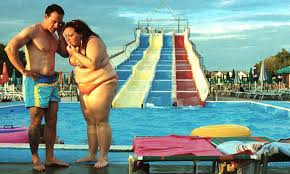
I watched Matteo Garrone’s ‘Reality’ last night for the third time, trying very hard to bring out my most critical eye and be as objective as possible, but the verdict remains the same: It is brilliant.
Brian watched it with me and was mesmerized by the eye-popping colors, reminiscent of the hyper-realistic technicolor that we grew up with, the authenticity of the characters, and the heartbreaking narrative. “When is this coming to the US?” He asked me, and I shook my head.
“Never,” I said. “Or rather, it’s come and gone.”
Reality is due out on DVD in America next month, but plans for its appearance in theaters, even the art houses, fell rather flat. It showed up at some film festivals and a few theaters on the coasts, but middle-America didn’t get a chance to see Garrone’s tragic and yet very funny story of Luciano, the Napoletano who literally loses his mind tying to get picked for an Italian reality show. It made something like $5,000 total in the US, but even worse, less than 2 million in Italy. And though I hesitate to sound like a People Magazine film critic in a snit over Ben Affleck being snubbed at the Oscars, I am in rather the same snit over Garrone’s lack of nominations and wins in, well, all of the Italian film awards.
Yes, Tornatore’s ‘La Migliore Offerta’ is great, but it’s not as good as Reality. This is a movie that should have shown brightly over other films like La Migliore Offerta but with Tornatore’s at over 13 million at the box office the public has spoken; they liked La Migliore Offerta about 11 million dollars more than they liked Reality.
But why?
I have the same uneasy curiousity about one of my favorite films in the last few years, Daniele Ciprì’s ‘È Stato Il Figlio’. At its premier at the Venice Film Festival I was sure it would be a giant hit, but I couldn’t have been more wrong. Ciprì’s equally tragic story of the family in the slums of Palermo fell even flatter, earning about three-quarters of a million and seen by even fewer people outside the Italian border.
Talking to Italians and Americans alike about ‘È Stato Il Figlio’ I heard a common complaint; they didn’t like the characters. They don’t like the father, Nicola (Toni Servillo) howling dialect heavy songs, they don’t like his temper and they don’t like the way that any of his family portrays Italians. “Italians aren’t like that,” an American woman explained to me as she defended her dislike for the film, and that’s a hard criticism to combat when I’m not sure what that even means. Italians aren’t like what, exactly?
Are movies like Reality and ‘È Stato Il Figlio’ seen as indictments of the Italian culture, politically incorrect home and abroad? Are we all too sensitive to tell stories about poor people that aren’t made to make them look any less than noble, salt-of -the-earth heroes? Are we afraid we’ll offend somebody if we accept the authenticity of people like Nicola and Luciano?
And is it even harder to do that if the characters are “south of the border”? (The border between the north and the south of Italy, that is.)
All signs indicate a sort of Italian identity crisis, a parallel universe in which Antonio Albanese’s ‘Cetto La Qualunque’ in Giulio Manfredonia’s Qualunquemente has audiences rolling in the aisles with laughter (and earning 16 million in Italy) over the overblown parody of life in Calabria, and turning their noses up at the bitterness of Nicola’s Palermo.
Maybe it’s just that Italian directors have, for so long, been telling personal stories like Tornatore’s ‘Baarìa’, strictly Italian experiences, and now we are unable to recognize attempts to tell stories that are more universal like the ones in Reality and È Stato Il Figlio. These aren’t simply unflattering stories about the frailness and sins of Italians; they are commentaries of every one of us and the weakness of mankind; they just happen to be told with Italians in the stories.
You can lead a horse to water but you can’t make him drink; I can’t force audiences to like what they don’t like, but I would urge them to give these films another look. They speak to the heart and the fragility of humanity, and in the telling of them their directors and actors haven’t thrown Italy under some kind of cultural bus and at their expense, as some seem to believe.
Don’t get all politically correct on me all of a sudden, Italy. I’ve always been so proud of your ability to tell your stories with a refreshing honesty and raw integrity that can be rare, especially these days.
 I Love Italian Everything