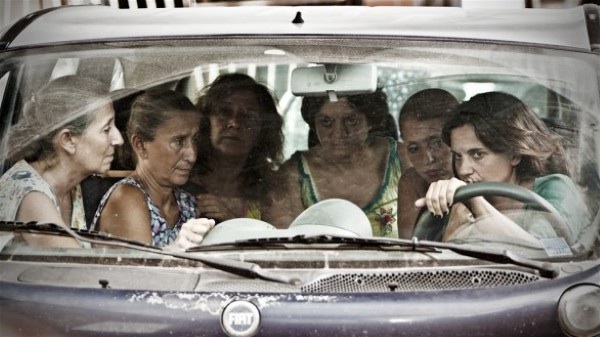
You know me; the Italian films in competition at the Venice Film Festival are likely to get extra credit from I Love Italian Movies, and I always want them to do well on a worldwide stage. But it was flawed, and not really on the level of its competition, so I’m going to be very careful to give Via Castellana Bandiera the criticism it deserves.
It’s got a great story, and stage director Emma Dante might have made it a pretty cool staged performance. Two women are having two very bad days; one an old woman who has lost her daughter is just sort of waiting to join her in the afterlife, and the other, a younger lesbian, Rosa, a with a self-loathing that I’m not sure I completely understood.
Rosa is on her way to her hometown, Palermo, against her will. Her girlfriend Clara has talked to into attending a wedding there, and as they drive around the city Rosa immediately regrets the decision and starts taking it out on Clara.
Having given up on any real purpose for living, the older woman, Samira, is in mourning for her daughter and stuck living with her daughter’s oafish husband. Driving the family home from a day at the beach, one in which she, instead, spends the day napping on her daughter’s grave and feeding the homeless dogs that live there, she meets Rosa and Clara on a narrow street.
There’s only room for one car at a time, so somebody has to back up and let the other pass.
The rest of the movie deals with the stand-off, and a more skillful director or a helpful editor might have made it brilliant. There’s a staginess to Via Castellana Bandiera that many films that would have been better off plays have, and though the dialogue is well done and at times, really very lovely, there’s just too much of it. Emma Dante didn’t know when to stop. She took a good story and ruined it with superfluous details.
Did the women have to be lesbians? Not that there’s anything wrong with that, but it felt forced as if to make a point that I didn’t get. And why make such a cliché of the poor Palermo neighborhood? Would everyone really be making ridiculous bets about who gives in first?
The night went on too long, not because of the things that were happening, they seemed very natural, but because there was too much theatrical pausing. Too many times in which I thought, “I get it! I get it! Move on!”
The ending is the best part, very moving and for a film in which I was having a hard time wondering how it would wrap up, very skillfully wrapped up. Thankfully Emma Dante didn’t try to redeem or even explain the characters or the situation with sentimentality and I appreciate that.
The audience at the Sala Grande on Lido applauded warmly but without much enthusiasm, and I left with that feeling one has when she’s been sitting too long and has started to look at her watch too much.
 I Love Italian Everything