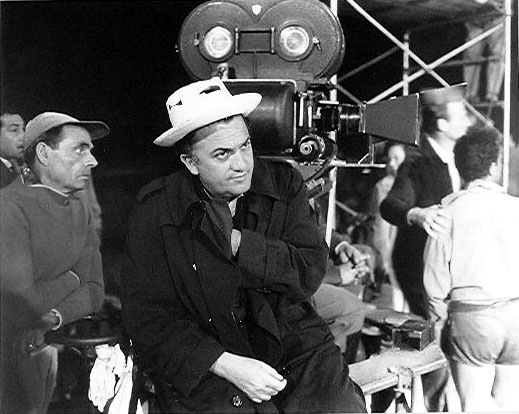
“When I am asked which city I’d prefer living in and they say, “London, Paris, Rome”, I say, in the end, if I’m to be sincere, it would be Cinecittà…theater 5 of Cinecittà is the most ideal place, with the best emotions, from thrills to ecstasy, it is what I feel looking at an empty theater, a space to refill, a world to create”.
– These are the words of Federico Fellini that have been engraved on the sign of the mythical theater that he created, for the dedication ceremony of its reopening twenty years after it closed.
Now reopened as part of a permanent exhibition called, ‘Perché Cinecittà’ (why Cinecittà), Minister Massimo Bray says that he considers Cinecittà, Rome’s version of Hollywood, part of the eternal city’s mythology, and Theater 5 “a place that isn’t just a memory, but one that I imagine as the future: a center of digital production, multi-media, and why not? A great museum of cinematography.”
The Minister visited the theater dedicated to the great director and will take part in ‘Perché Cinecittà’, the first of the new exhibition spaces that will be made permanent and will be filled with photographs from important films contributed by Insitituto Luce-Cinecittà’.
To do the honors for Theater 5, the president of Cinecittà Studios Luigi Abete has invited celebrated guests, Nicola Borrelli, Roberto Cicutto, Giuseppe Basso, Jean Gili, Nicoletta Ercole, Enrico Vanzina, Aurelio e Luigi De Laurentiis, Gianni Letta, Paolo Ferrari, Stefano Rulli, Lamberto Mancini, Ivano De Matteo, Paolo Del Brocco, Marcello Foti, Marina Cicogna, Aurelio Regina, Leopoldo Mastelloni.
“It’s not only a tribute to the famous filmmaker”, said Abete, “but also a memory that will become the future of the studios, integrating projects and making the best use of the area.”added the mayor of Rome, Ignazio Marino, who has been a reliable champion of Cinecittà Studios, “We have to remain a place of production and post-production.”
Claudia Cardinale, who worked on 8 1/2 in the same year that she worked with Luchino Visconti on his film, Il Gattopardo (the leopard) said, “Luchino wanted me as a brunette, and Federico wanted me blonde. With Federico, there were never any scripts, using improvisation, he was the only director that worked without any screenwriters. He asked his actors to act by the numbers. ‘you are in Africa, communicate energy, you are the muse’, he told me.
Dante Ferrett’s memory of Fellini: “He taught me how to lie”.
Said Vittorio Storaro, “(he had an) extraordinary visionary capacity”.
And from Gabriele Salvatores, “Arriving at Rome with my first film it was the great director that was the first to inspire me to make films.”
And maybe the best of the memories, a bittersweet one from Carlo Verdone ” One night, it was late and I was returning from dinner with friends and I saw someone on Via del Babbuino (a street in Rome near Trevi Fountain), leaning against a wall and I realized that it was Federico Fellini. I was wondering why he was out at night all by himself when he approached me and said, “Ciao Carletto, you know I sleep very little at night.”
“But what are you doing out here?”, I asked him.
“I’m waiting for a police car, I’m out here looking for something to happen, getting ideas.”
“It was a very poetic image for a night at the end of November,” said Verdone.
At the end of the ceremony, important words to remember: “Cinecittà needs a new and serious project tied to this mission, it needs real work, because another country, a better one, will come from this.”
Translated from the Italian (badly, sorry about that) from Cinecittà News.
 I Love Italian Everything