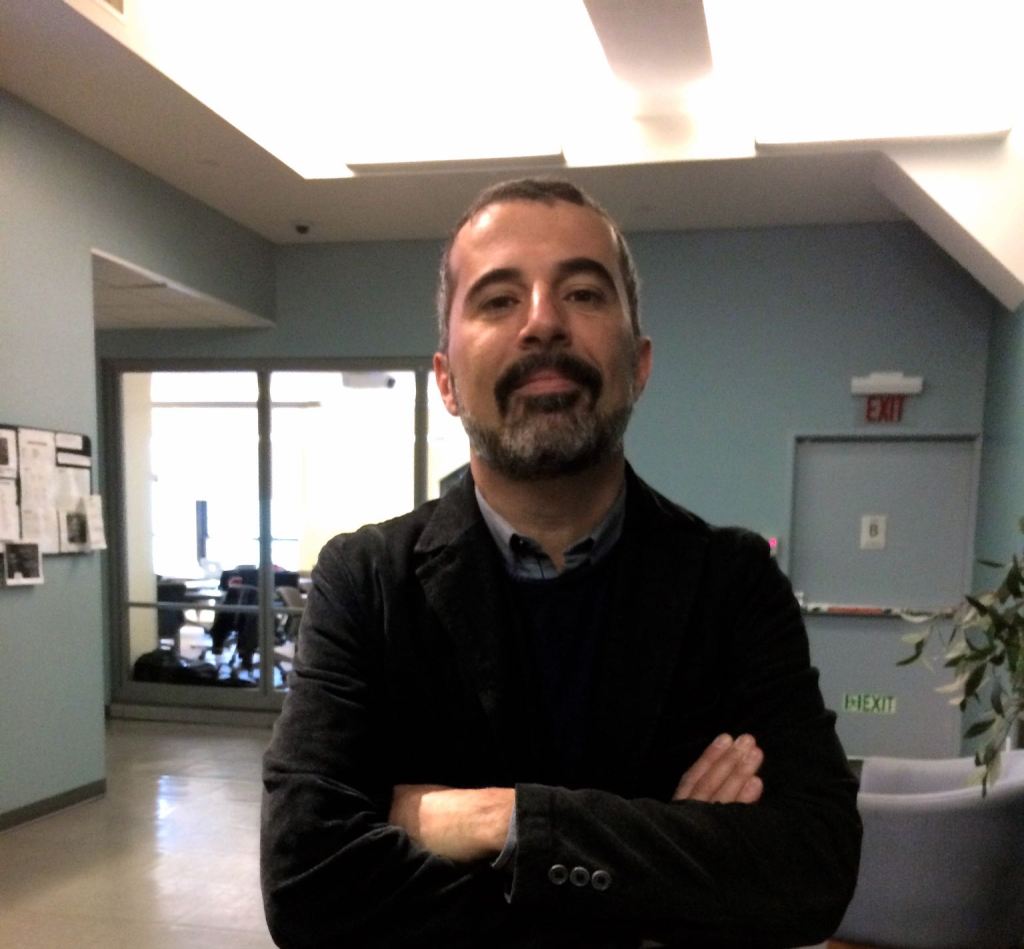
My interview with Francesco Munzi, director of Black Souls, coming soon to US theaters.
Having arrived early for my interview with director Francesco Munzi I was looking for a place to get a cup of coffee and I spotted Munzi standing outside the place we’d arranged to meet.
“Francesco?” I called as I approached him, unable to ignore how very good-looking he is in person.
“You’re ‘I Love Italian Movies’?” He looked suspicious. It was St.Patricks Day in New York City and at 11:00 in the morning I was already surrounded by green garbed and schnockered revelers.
He was about to do a TV interview at the CUNY journalism school, and our appointment was for right after that, so I asked it I could bring him a coffee. “Thanks”, he nodded, “but not one of those big American ones; OK?”
I may be American and I do love an extra-large McDonald’s coffee, but I know enough not to bring a “big gulp” coffee cup for an Italian.
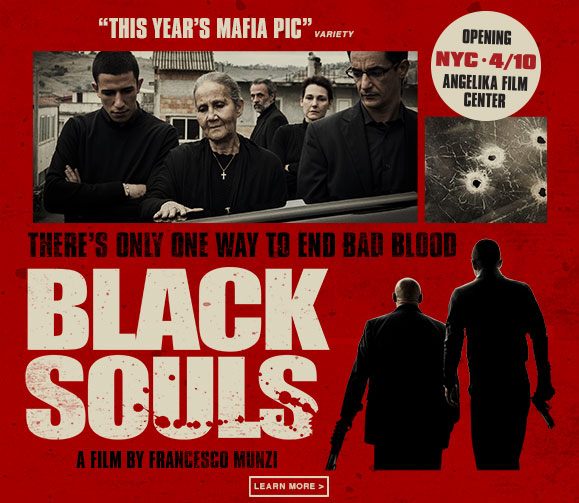
So I brought Francesco his caffè doppio and sat down with him to talk about his newest film, Anime Nere (Black Souls) opening in New York at the Angelika Film Center on April 10.
I’d seen Anime Nere at its premier at the Venice Film Festival last August, and my readers know that I haven’t stopped talking about it since. Based on a novel by Gioacchino Criaco, “Black Souls” is being called by some “the new Gomorra” (Matteo Garrone’s film) but as Munzi confirmed, it’s “not just a” mafia movie.
BLACK SOULS IN THEATERS APRIL 10
In Black Souls, three brothers who are part of a criminal organization based in Calabria, the ‘Ndrangheta, see the future of the family’s heroin/goat herding organization in different ways. The interactions are authentic and the dialogue in Calabrian dialect realistic. Mafia movie aficionados will find the criminals in Anime Nere satisfying and those who just love a good family drama will be equally drawn in.
“This isn’t the story of a Mafia war, this is a war within one family”, said Munzi, “with all the cultures and contradictions that are inside all families.”
“It’s a tragedy”, he continued, “and it speaks of emotions and not just crime. I like classic Dostoevsky dramas and I wanted to recreate the visual aspects of the great tragedies.
Munzi, a Roman, didn’t know much about the little Calabrian village of Africo, the film’s location and the heart of the ‘Ndrangheta territory, so he decided to go live there for six months.
“I was afraid”, he told me. “A lot of journalists and judges told me not to go there, but I needed to go because I’m from Rome and I needed to see it. I called Gioacchino Criaco, who’s from Africo, and he traveled there with me and introduced me to the townspeople.”
I’d read that Munzi had said that he’d found there a southern Italy that he’d not known before, one that didn’t seem to see itself as part of Italy. “Calabrians told me that they identify with the Palestinians”, he said,”and actually feel like they’ve been invaded by Italy.”
As you might guess, after living there for a while Munzi found that the situation was not black and white, and as people warmed up to him they were eager to get involved in making the movie, working as drivers and even actors.
With the popularity of the Italian TV show ‘Gomorra, The Series’, organized crime is a hot topic right now and some Italians fret that it promotes bad stereotypes for Italy. I wondered if that was a concern for Munzi.
“I don’t worry about that”, he told me. “If you speak about relationships and if the characters are well-written, you can avoid stereotypes; at least I hope I have.
And he has. Francesco Munzi is one of those directors that I am most interested in these days. Italian movies have never been better because of ones like him who, as he says, “speak of our reality, take risks, and want to invent something new.”
I asked him what he is doing that is different from the old directors, and he was much too modest, claiming that he’s not alone, but part of a group of filmmakers who look to their grandfathers, and not their fathers, for inspiration,trying to create something that is “somewhere between our grandfathers and the future.”
He says that he wants to distance himself from the cinema of the last 30 years, to research something that interests him and make it entertaining for the audience.
In the end, he can only do what he loves, he told me, and even the offer of a big fat Hollywood paycheck would not persuade him to make a Hollywood-style movie that he had no interest in.
Munzi says that he likes the style of what is being done on television and would like to do something that is like that; here’s an idea…
With the research and the thought he’s put into the ‘Ndrangheta, the people of Calabria, and the pathology of screwed-up families in general, I’m positive I’d be binge-watching Anime Nere,The TV Series when it made its way to America.
I’m eagerly anticipating every new project from Francesco Munzi.
 I Love Italian Everything