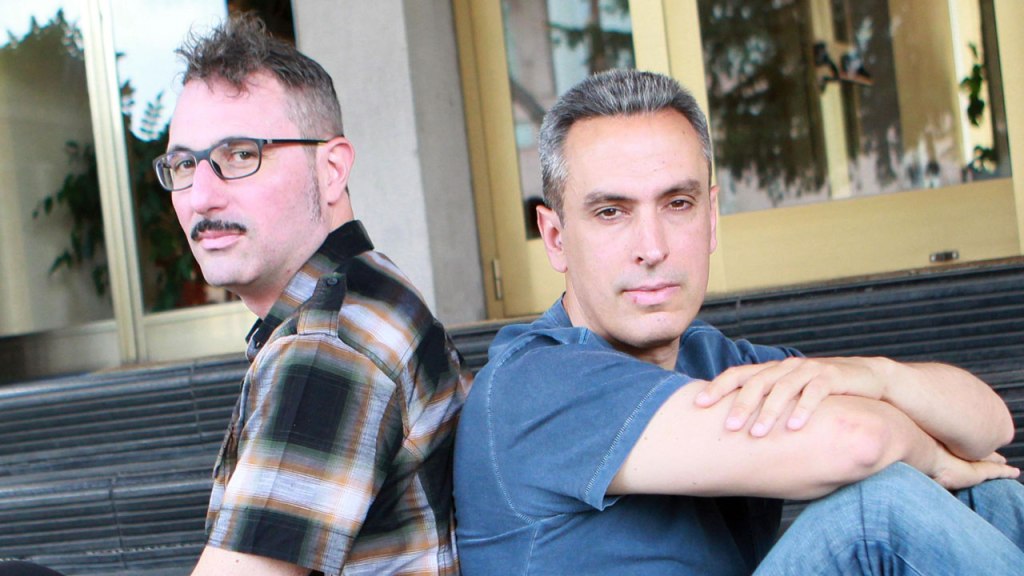
I spoke with Antonio Piazza yesterday about their enormous success at the Sundance Institute Screenwriters’ Lab and their new film Sicilian Ghost Story.
I’m not afraid to ask stupid questions, so I asked, “What exactly is the Sundance Institute Screenwriters’ Lab?” I mean, I know it’s a giant honor to be selected for it. Only 12 projects from around the world are chosen, but what exactly did the two of them do all week?
“It was a week of conversations about our script with filmmakers and advisors like Thomas Bidegain the screenwriter of the 2009 “A Prophet”. And Robert Redford was there.”
The script in question accepted for the intensive workshop is Sicilian Ghost Story, in pre-production and due to start filming in 2016, one that is already highly anticipated and already piling on the honors. Sicilian Ghost Story is among winners of this year’s Sundance Institute Global Filmmaking Award.
Each year the Award honors “emerging directors from different global regions who possess the originality, talent and vision to be celebrated as the future of world cinema”. And more good news: The Match Factory has taken international sales for the film.
Sicilian Ghost Story is about a 13-year-old Sicilian girl named Luna who refuses to accept the sudden disappearance of Giuseppe, the young boy she loves, when he is kidnapped because he is the son of a Mafia boss. It combines romance with fantasy and drama and as they say in Italy, non vedo l’ora! (I can’t wait.)
When I asked if it had been cast, Piazza said, “Yes…and no.”
Most of the roles are being filmed by inexperienced actors, and the two main protagonists are 12-year-olds, and so an extensive search for just the right pre-teens is still underway. (Attention 12-year-olds of Sicily! Do you want to be a star?) There will be a few parts for seasoned actors and may I suggest my favorite Sicilian actor, Luigi Lo Cascio, who appeared in Grassadonia and Piazza’s first feature-length film Salvo.
WATCH LUIGI LO CASCIO IN SALVO
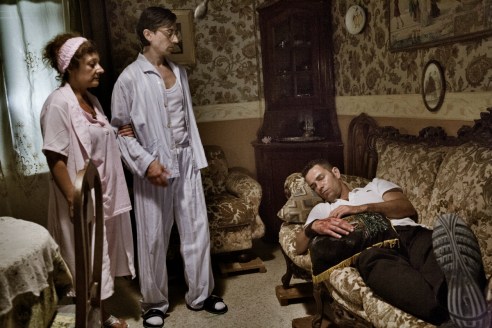
I asked about how it works, the creative process for the two directors. “Who does what? Do you write every word together?”
“At first, yes. We were originally writers and we do the writing and rewriting together. Sometimes we work on the dialogue separately.”
But when it comes to the directing, “Fabio is very active, all over the place, all over the set with the actors. I’m in front of the monitor, watching the scene.”
Can the actors improvise or do they have to stick to the script? “We welcome the ideas of the actors, I mean, it’s not a bible.”
Antonio says that he and Fabio agree with me, that there has been a reawakening of Italian cinema in the last few years, and “the exciting moment”, he says, “began with Sorrentino and Garrone and their personal voices.”
“They put Italy on the map”, he says. “There was a gap, especially in the ’80s, between the smaller, more artistic films and the bigger, more commercial films.” He talked about how that gap is narrowing, and how the films today can be smart and creative and still commercially successful and entertaining.
Films like Salvo, the 2013 Critics Week Grand Prix winner at Cannes, are precisely the kind of film to make this happen. Slick, smart, beautifully filmed and compelling from start to finish, movies like Salvo and filmmakers like Grassadonia and Piazza are what’s putting Italy back on the map. Sundance got it right: They truly are “emerging directors who possess the originality, talent and vision to be celebrated as the future of world cinema”.
 I Love Italian Everything