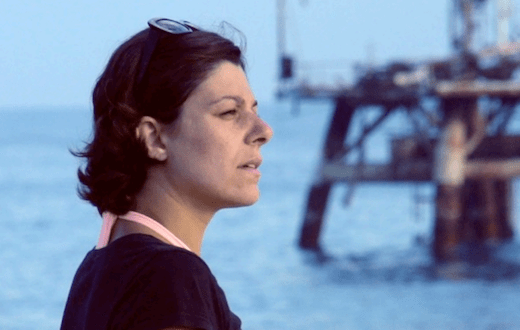
Gian Luca Rossi’s documentary will mean something a little extra to Italian Americans.
TRAILER COAL SEA from Gian Luca Rossi on Vimeo.
When Americans talk about Italy and Italians, they aren’t always talking about the same thing. Tourists think of Venetian gondolas, the Tuscan countryside, and la dolce vita.
When Italian Americans think of Italy, they’re probably thinking of the land of their grandfathers, Campania, Sicily, and Calabria. I’ve witnessed this first-hand, because my husband’s family came from Reggio Calabria, and even if he’s only heard the stories and have never seen it with his own eyes, the ancestral tug is forte forte, very strong.
Italian Americans who have never set foot in Italy understand sometimes even better than the modern citizens of Milan or Verona what Rossi shows in Mare Carbone (Coal Sea), the part of Italy that, as the saying goes, “Il Signore ha dimenticato le scarpe,” (God has forgotten his shoes).
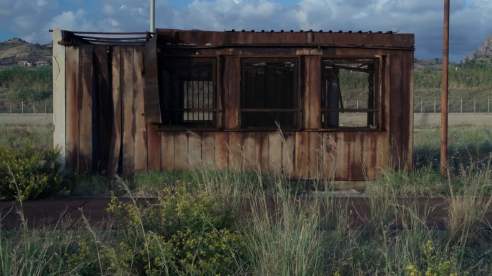
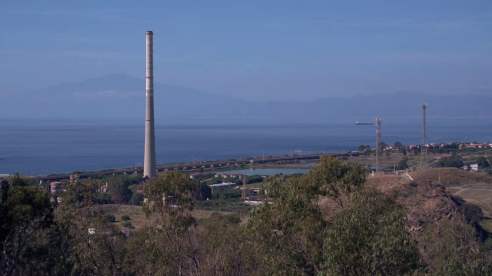
“When I see that smoke stack, standing high on the marshes of Saline, I know that I have arrived. I’m back at the place I love more. I don’t live there, but it’s where my home is,” says Margherita, the film’s protagonist, born and raised in Aosta (northern Italy), but like my husband, has Calabrian grandparents. Eight months pregnant and the in the middle of a bit of an identity crisis, decides to take a southern road trip to get reacquainted with her roots. As a southern Italian, she’s always been a bit of an outsider in Aosta (kind of like an Alabama girl with a heavy southern accent fitting in a city like Boston).
She arrives in Calabria and finds that there are plans for the construction of a coal plant at the ruin of an abandoned chemical plant, and the natives aren’t keen on the idea. The local government has promised jobs and development, including a luxury seaside resort, but nobody’s buying it.
“Everybody knows that billionaires like vacationing next to coal plants,” a resident says sarcastically.
They get it. Calabrians are about to be screwed over yet another time.
“We always accept what arrives,” says another resident. “First with the unification, Garibaldi, then fascism, then the resistance. We have an involuntary cynicism here, not studied or chosen.”
When in the ’70s the chemical plant was built and then immediately abandoned leaving behind a rusty eyesore, that too was accepted, but the proposed coal plant? Calabrians were apparently putting down their collective foot and saying, “no way”.
Mare Carbone is powerful and bittersweet, and the words and thoughts of the townspeople couldn’t be more eloquently stated had Rossi hired poets to write their lines for them.
“There are those who leave themselves to be dragged by the sirocco, and those who try to resist”, said one of the men interviewed, and it should come as no surprise that both those who were dragged and those who resisted will always be regarded with equal affection by Italian Americans with Calabrian relatives.
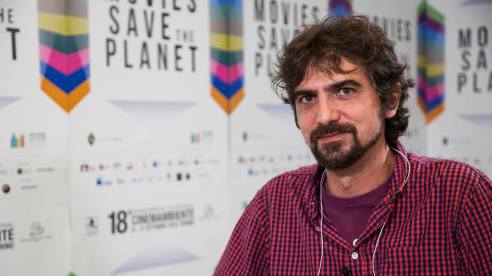
Gian Luca Rossi’s documentary is making the rounds at film festivals and we’ll let you know when it makes it to the United States.
 I Love Italian Everything