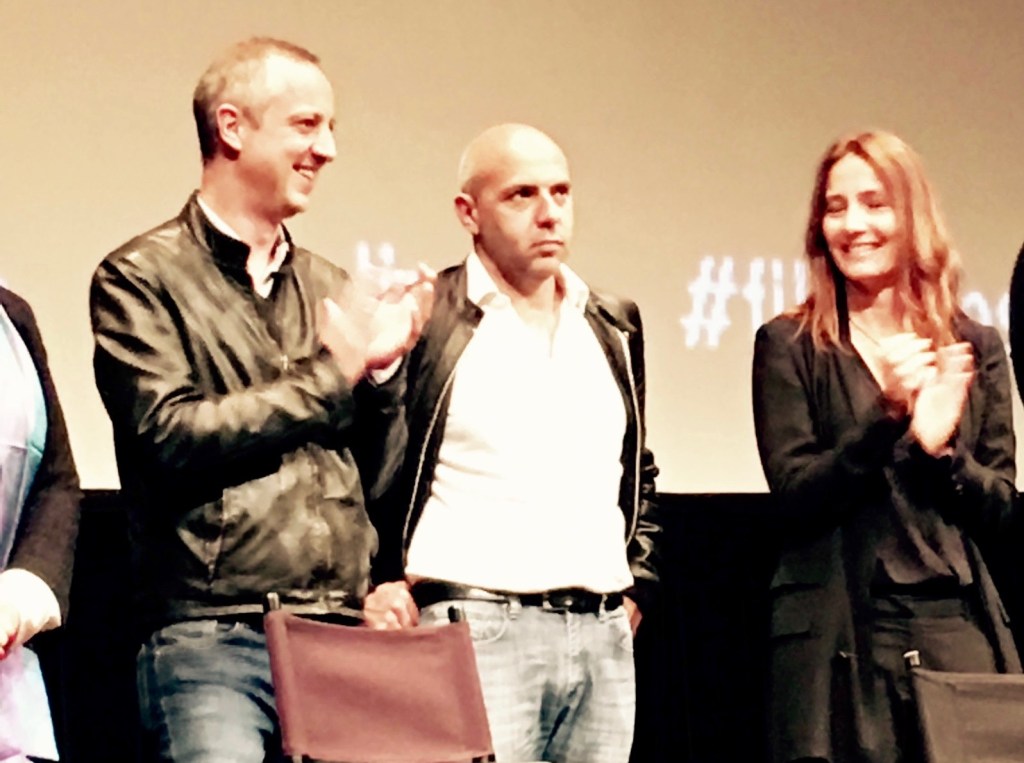
Marra talks about his film, La Prima Luce (First Light), one that he calls a “Kramer vs Kramer” for 2016.
 In this story of an international custody dispute Riccardo Scamarcio plays Marco, an Italian lawyer who lives in Bari with Martina, a woman from Chile, and their seven-year old son. For Marco, Italy is home, but for Martina, it’s becoming an increasingly cold and confining prison. “I want to go home”, she tells him, over and again. “I want to go home”, she says, and then finally, “I’m going home.” But Marco doesn’t hear her. He doesn’t see, or doesn’t care that she’s been unhappy for ages. He dismisses her concerns with his parenting style (she calls it “violent”, but I’m not so sure), and he seems not to notice that in all her years living in Italy she’s never really assimilated.
I sat down with director Vincenzo Marra and asked him about this modern-day horror story in which a parent can run away with a child and there’s nothing the other parent can do about it.

I jumped right in and asked about Riccardo Scamarcio; what made Marra choose him for the lead? And what’s up with this handsome movie star taking all these (at the very least) slightly unflattering roles?
“I really can’t speak for him, but I know that he was very deeply motivated for this film. Although he has no children himself, he seems to have this real affection for fatherhood.”
And then I had to ask myself, did handsome Scamarcio affect my sympathy for his character? Was I leaning toward Marco’s side because Riccardo Scamarcio is darned good-looking? I mean, what kind of monster would do that to adorable Riccardo Scamarcio?
So I asked Marra if making the movie, he’d taken sides.
“Absolutely not,” he told me.”In the first part, the mother, Martina, a foreigner, is the more likable character. We empathize with her more; she feels like lonely, like a prisoner, oppressed, and so the audience automatically empathizes with her. But in second part, the male character, who is presented at first as being very aggressive and arrogant, harsh you empathize with him because taking a child away from his father is an abomination, and in an end, there’s a sort of hope, as a result of that stupid conflict, and it might be somewhat reminiscent of Kramer Vs Kramer. When there is a custody battle what has to prevail is the interest of the child.”

I told Marra that I’d seen it a little differently, that I’d felt more empathetic toward the dad from beginning to end, and maybe I was expecting him to give me some insight into what I was feeling, as if that were possible, but instead he just shook his heads and gave me the facts:
“Unfortunately,” he said, “it’s incontrovertible. In 85% of the cases, it’s the mother who gets the child, even though gender shouldn’t be the determiner of justice. When two people love each other, live together, have a child together, in a certain sense that’s going to require their best, but when they are from two countries, in a period like today, living in close quarters, with problems with Visas and things like that and all the other difficulties, it’s actually a miracle of history (that it ever works), however when they break up the most important thing is what’s in the greatest interest of the child.”
“I think about my mother,” he continued, “who fought the battle for women’s rights in the ’70s in Italy”, but now he sees a need for a change in the laws.
I asked Marra if it had been necessary to do a lot of research into custody law to make the film. ”
“There is convention, the Hague convention, that came out in the 1990s, that tries to create international rules when there is a conflict like this one for the custody of a child. Unfortunately many countries don’t adhere to it,” he told me.
“Unfortunately,” he said, “some countries, like the US tend to see conflicts like this one as a sort of football match, where it’s the US vs Canada, or the US vs Mexico, and America’s not alone in not adhering to the convention. The strange bedfellows include Germany, Denmark, Russia, also the Arab countries and I think that the failure of all these countries to adhere to the convention erodes the common cultural continuity.”
And the inspiration for this film?
“Fear,” he said, without skipping a beat. “That it would happen to me. When I was a teenager my father would sit me down and make me watch one films, and one of the films I learned by heart was Kramer vs Kramer. My film is a kind of Kramer vs Kramer for 2016.”
 I Love Italian Everything