Documentary film at its finest, L’esercito Più Piccolo del Mondo (The World’s Smallest Army) is a film full of hope for humanity.
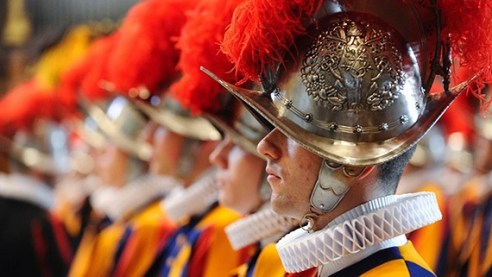
Maybe it’s because I’m Catholic, or because I love Rome, or because director Gianfranco Pannone has so skillfully and sweetly told the story of young men in today’s Vatican Swiss Guards that I have so much affection for this wonderful documentary that premiered at last year’s Venice Film Festival.
Probably all of the above, with the addition of the appeal of the protagonists, exemplary young men who have just arrived at Vatican City for their training, sincere and ready to work hard as part of L’Esercito Più Piccolo Del Mondo, The Smallest Army in the World.
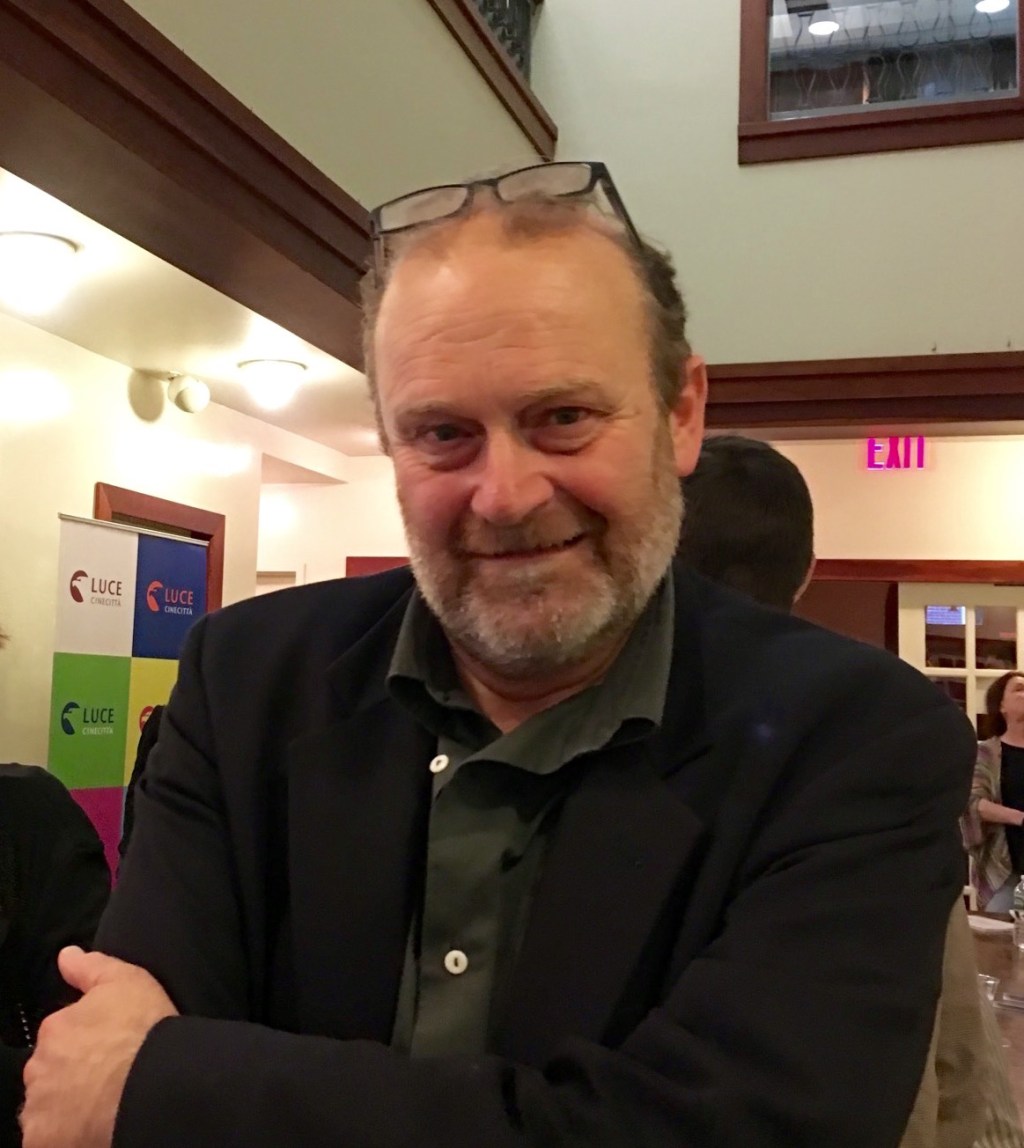
I spoke with Pannone about his exceptional documentary, and about modern Italian documentary in general.

I interviewed Gianfranco Rosi (Sacro GRA) a few years ago and he told me that he didn’t like the kind of documentary that Michael Moore makes; according to him, Moore is too negative, ““I don’t like this kind of filmmaking”, he told me. “Everybody wants to be a little Michael Moore. I like to capture positive elements of the world.” You seem to be of the same kind of documentary maker; am I right?
I’m not a fan of Michael Moore because I don’t like edgy cinema and in this, Gianfranco Rosi and I are in agreement. I prefer a kind of documentary that questions, that believes in an active participant, that provokes. I like to plant doubt, and that’s what Moore doesn’t do. What he says in his films often are things that I agree with, but I don’t like his way of taking the viewer by the hand, as if he were a child. Ultimately you don’t go to see a Michael Moore film to discover anything new, but to have something confirmed, and I this is what I don’t like. I have great respect for Moore, but I think more about film that is less “state sponsored”, that believes in something very important and is one that expresses a thought. I prefer cinema of style, that knows how to take the audience using the language creatively rather than expressing itself with the words, words that can very easily become slogans.
L’esercito Più Piccolo del Mondo made me happy, happy for humanity. I liked getting to know people like the ones in the film. What do you want the public to take from it?
I’d like audiences to take an urgent need for humanity, the same humanity that Pope Francis passed on to me in the months that I was filming, I believe that today there is a great need to pass on to others the power of humanity to those who need empathy, attention, and someone to hear them. And those that have seen it (the film) I think have recognized the human force that my film follows in the 80 minutes of the story. From the beginning, the idea of L’esercito…it was to give to the world a group of young men that are like so many others, but have decided to serve the church in 16th century clothes. A curious and confusing thing. Did I succeed? It’s not for me to say, but to me, the public seemed curious to know. Certainly this film gave me so much in human terms. It was a real honor to be able to be able to achieve it and to bring it to movie theaters.
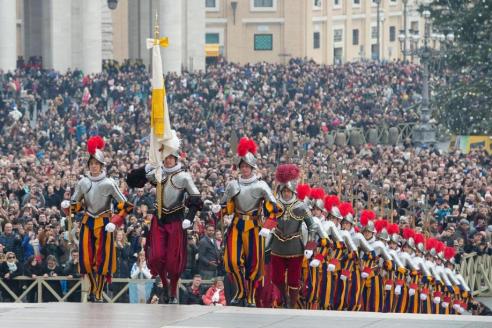
What do you say to people who think that the Swiss Guard is no longer necessary?
For a long time I thought that there is no need for the Swiss Guard, but this film changed my mind. I learned that the world needs symbols that they can recognize. And if it’s true that seeing young men in 16th century clothes seems anachronistic, it’s equally true that the Swiss Guard represents the times with a secular past that has its contradictions, but everyone needs. Because in the Jung school of thought, we take inside us a past that we didn’t personally experience, and in the end, we are our parents, our city, our country…and even those without faith are also part of 2000 years of rich history and controversy. And it’s intoxicating to be able to see this secular past as our own. Maybe people know it right away, but I believe that something deeper is coming for the soldiers that dress in uniforms from another time and guard the Vatican doors.
Could you tell me about the state of the documentary in Italy? It seems pretty strong. It seems like there is money there for it.
Italian documentary has never enjoyed such good health as it does today. Of course, good health in terms of creativity, less so for the economic side of it. You know, there is a lot of energy around “cinema del reale”, in the last few years some very interesting people in their thirties have joined my generation and established themselves; and they aren’t missing out on the awards and the recognition in the European festivals.
I think all this depends on 20 years of fraudulent politics that saw its peak in the Silvio Berlusconi years, perceived by many as “the great huckster”.
Many filmmakers went in person to look for the real country, the power that it was hiding, telling about it from inside many intricate stories of the past and above all the present of this Italy, one that it’s not wrong to call a national mosaic. A story of a country that, in contrast, TV hasn’t always shown, sometimes because of political censorship. However the investments in auteur documentaries fail. Few, in fact, make it to public television, and support comes rather from the regional film commissions. The results are weak, because in my opinion it lacks a courageous marketing strategy for all cinema, even fiction based film.
Can you tell me about your next project?
Right now I am working on a fictional film called Corpo a Corpo (Hand to Hand). It is the story of a difficult relationship between a father and a daughter who is just barely out of her teens He’s Tunisian and he’s lived in Italy for 30 years, a secular leftist, and he has to deal with a daughter that prays in Arabic to Mecca and practices Thai boxing.
It scares him, because he thinks that she might be a soldier for radical Islam, but he’s wrong. There’s a blindness in the father, incapable of recognizing his daughter’s concerns. Corpo a Corpo is a film about the deep crisis of secularism, incapable of answering an increasingly troubled world. I hope to make it happen next year.
 I Love Italian Everything